
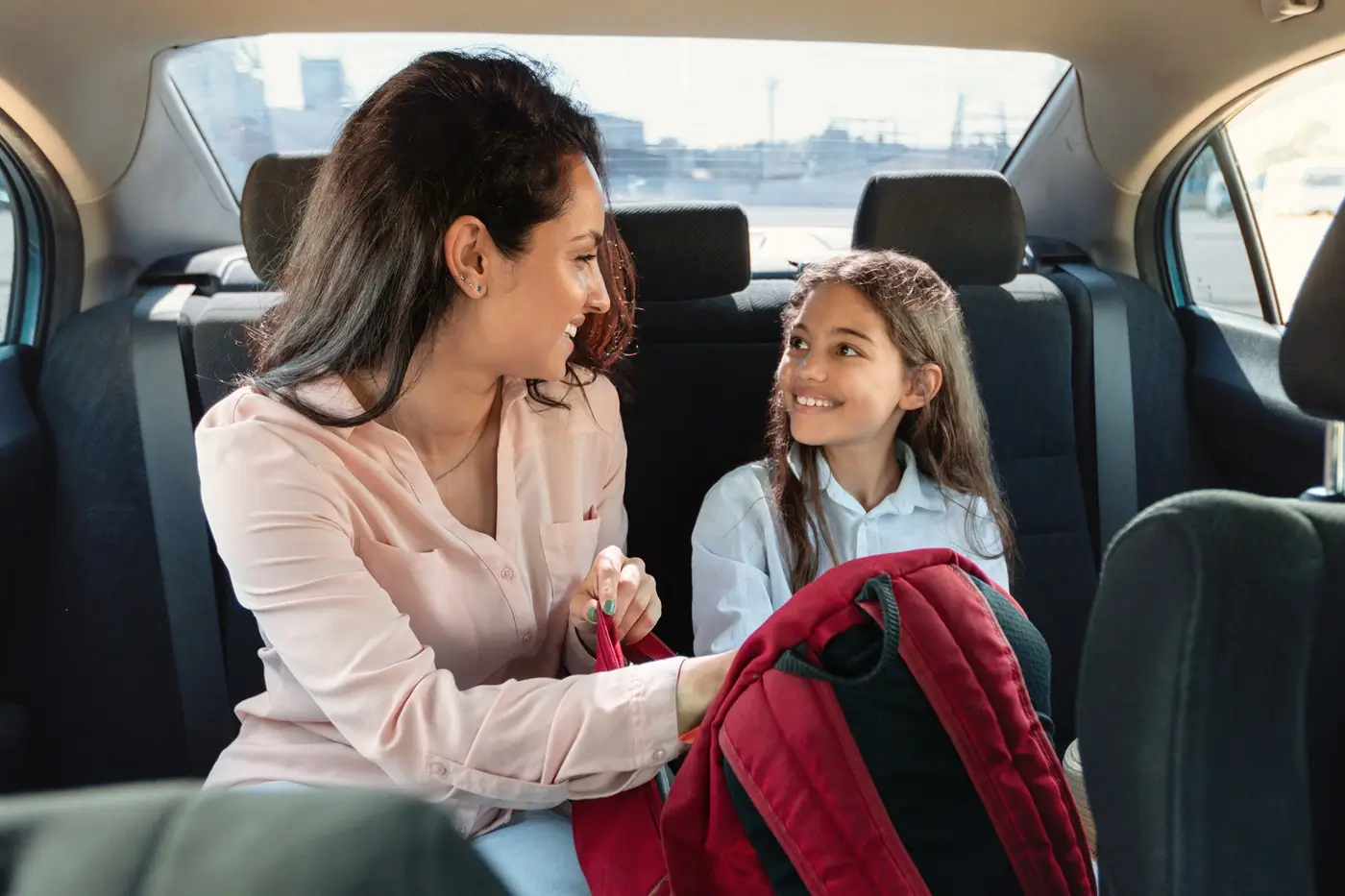
The school is four miles one way, the office is six miles the other, and both expect you at 08:30.
More families are solving that daily clash with a school taxi, yet most parents have the same questions before they book one. Is it safe, who checks the driver, what does the law say about child seats, and how does a regular booking actually work?
This guide explains private hire school transport from a parent’s point of view, covering safety, costs, and setup. It draws on years of running pre-booked private hire across Surrey at Camberley Cars, where the morning diary fills with regular runs long before the airport jobs.
What Is Private Hire School Transport?
Private hire school transport is a pre-booked, licensed taxi taking a child to and from school regularly, usually the same driver at the same time each day. It is parent-booked and paid, which makes it different from council-arranged home-to-school transport.
Councils provide free transport only for eligible children, broadly those whose nearest school is over two miles away for under-8s, over three miles for older children, or who have special educational needs. A parent-booked school taxi covers every other family: door to door, on your schedule.
Council transport covers eligible children; a parent-booked taxi covers everyone else.
Also Read: Camberley to Heathrow Taxi: Cost, Time & What to Expect
Is a School Taxi Safe? What Parents Should Check
A safe school taxi starts with a licensed operator and an enhanced DBS-checked driver. In England, private hire drivers undergo an enhanced DBS check as part of their licence, so a properly licensed driver has already been vetted.
Beyond the paperwork, ask for a consistent, named driver, because a familiar face at the gate matters more to a child than anything else on the checklist. A good operator will also explain how they confirm pickups, what happens if the regular driver is off, and how they communicate with parents.
The right operator answers safeguarding questions without hesitation; a vague answer is your cue to look elsewhere.
Child Seats, Boosters, and the Law
Licensed taxis and private hire vehicles are not legally required to provide child seats, so parents should arrange the seat themselves. Without one, a child may travel in the rear, using an adult belt if aged three or over. That exemption exists for practical reasons; a properly fitted seat or booster remains the safest option.
For a daily school run, the simple fix is to supply your own booster and agree with the operator how it is stored or handed over each morning.
The law allows a school-age child in the rear with an adult belt, but a booster is safer.
How Regular Term Time Bookings Work
A term time taxi service holds the same slot for your child every school day, with the time, address, and fare agreed in advance. Once it is set up, there is nothing to arrange each morning; the car simply arrives.
Operators plan these runs carefully. The road outside a school gate is calm at 08:10 and gridlocked by 08:25, so an experienced driver collects five minutes earlier than parents expect. Regular slots are usually blocked in the diary before one-off work is accepted in that window.
A term-time booking holds the driver, the time, and the fare for the whole term.
School Transport Options Compared
Most families are choosing between three options, and each suits a different situation. The comparison below shows where a school taxi fits.
| Option | Cost | Flexibility | Best for |
| Council home-to-school transport | Free if eligible | Fixed routes and times | Children meeting distance or SEND criteria |
| Parent-booked school taxi | Paid, agreed fare | Door to door, your schedule | Working parents, awkward routes |
| Informal lift sharing | Shared fuel costs | Depends on other families | Occasional cover, short distances |
For daily reliability without eligibility rules, a parent-booked private hire run is the most dependable of the three.
College Students, Sixth Form, and School Trips
School taxis are not only for young children. Older students use a taxi to college or sixth form independently, within rules agreed between parents and the operator, since there is no single legal minimum age for travelling alone and operators set their own policies.
For groups, a school minibus service covers sports fixtures, after-school clubs, and school trip transport, moving six to eight students with one driver. Group school transport like this is usually booked through the school or by parents together, with a fixed price for the run.
Older students travel independently under agreed rules; younger children are usually accompanied.
Also Read: Corporate Airport Transfers Guide For UK Business Travel
Setting Up a School Run with an Operator
Setting up a daily school taxi takes one conversation if you arrive with the right questions. Confirm the operator is licensed, ask which council licenses them, and check the driver holds an enhanced DBS.
Then agree the practical details: a named regular driver, the pickup and drop-off points, the fare, inset days, and how cover works if the driver is ill. Families in Camberley, Frimley, Farnborough, Yateley, Blackwater, and Sandhurst can put these same questions to Camberley Cars, a licensed pre-booked private hire operator working this Surrey belt daily. For families outside this area, a licensed local operator near you is the right starting point.
FAQs
Are school taxi drivers DBS checked?
Yes, licensed private hire drivers in England undergo an enhanced DBS check as part of their driver licence, which is the highest level of criminal record check. Even so, always confirm the operator and driver are properly licensed, and ask whether drivers have any additional safeguarding training. A reputable operator will answer these questions openly and show licence details on request.
Can a child travel alone in a school taxi?
There is no single legal minimum age for a child travelling alone in a taxi, so it comes down to the operator’s policy and the parent’s judgement. Most operators agree arrangements in advance, such as confirmation at drop-off. Older students commonly travel to school, sixth form, or college alone; younger children are usually accompanied or handed to staff.
Do school taxis provide child seats?
Taxis and private hire vehicles are not legally required to provide child seats. Without one, a child aged three or over may travel in the rear using an adult seat belt, though a properly fitted seat or booster is always safer. For a daily run, most parents supply their own booster and agree with the operator how it is stored or handed over.
How much does a school run taxi cost?
There is no standard price, because the fare depends on the distance, trips per week, and the vehicle needed. Regular term time bookings are usually quoted as a set fare per journey or per week, agreed before the run starts. Ask for a fixed quote for your exact route, and check how inset days and holidays are handled.
Can I book a taxi for after school club pickups?
Yes. An after school club taxi works like a regular school run, just later in the day, booked for every day or set days each week. Give the operator the club’s finish time, the exact pickup point, and a staff contact, and agree how the driver confirms collection. One-off pickups can also be arranged when plans change.
The Bottom Line
Private hire school transport gives working parents a dependable daily routine: a licensed, enhanced DBS-checked driver, the same slot each school day, and a fare agreed for the term. Check the operator’s licence, arrange a booster seat, and agree communication and cover before the first run. Council transport covers eligible children, while a parent-booked taxi suits everyone else. In the Camberley area, Camberley Cars runs pre-booked private hire across the Surrey belt and can talk through regular term-time arrangements.
.
Follow Us
- Google Maps Link: Camberley Cars
- Facebook Link: Camberley-Cars
- Instagram Link: Camberleycars
- TripAdvisor Review: Camberley_Cars
- Taxi Code Reviews: Camberley-Cars
Rated by Our Customers on Google